
Advertisement
When last did you walk in a pine forest, where the swish of your shoes through the bed of pine needles was punctuated by the occasional thwack as a pine cone fell to the ground? Ordinarily, most of us would bend down, pick it up, breathe in the heady pine scent and either toss it aside or keep it to add to the Christmas tree. Some, however, would take a second look – like a team of Swiss scientists did – and learn from nature’s amazing future-proofing strategies.
In the case of the humble pine cone, it future-proofs itself by ensuring that it releases its seeds at the perfect time, when the conditions are best suited for dispersal. In warm, dry weather, when conditions are optimal, the seed-bearing scales of the pine cone open, enabling the paper-thin seeds to be carried away in the breeze, whereas in cooler, humid conditions the scales close tightly, protecting the seeds from being damaged by the damp weather. Ingenious, one says … absolutely!
Biomimicry (noun) is the ‘design and production of materials, structures and systems modelled on biological entities and processes’. In lay terms it’s when designers, engineers and product developers are so blown away by what nature does that they just cannot help but be inspired to copy it in some way. And that’s what happened when a team of material scientists from ETH Zürich, a science, technology, engineering and mathematics university in the city, were inspired by – generally – how plant components respond to external stimuli, and – specifically – the way the pine cone’s scales work. When we look at a pine cone, we see just the woody scales, but each scale consists of two firmly connected layers with rigid fibres running perpendicular to one another. It is this alignment that allows the differential expansion.
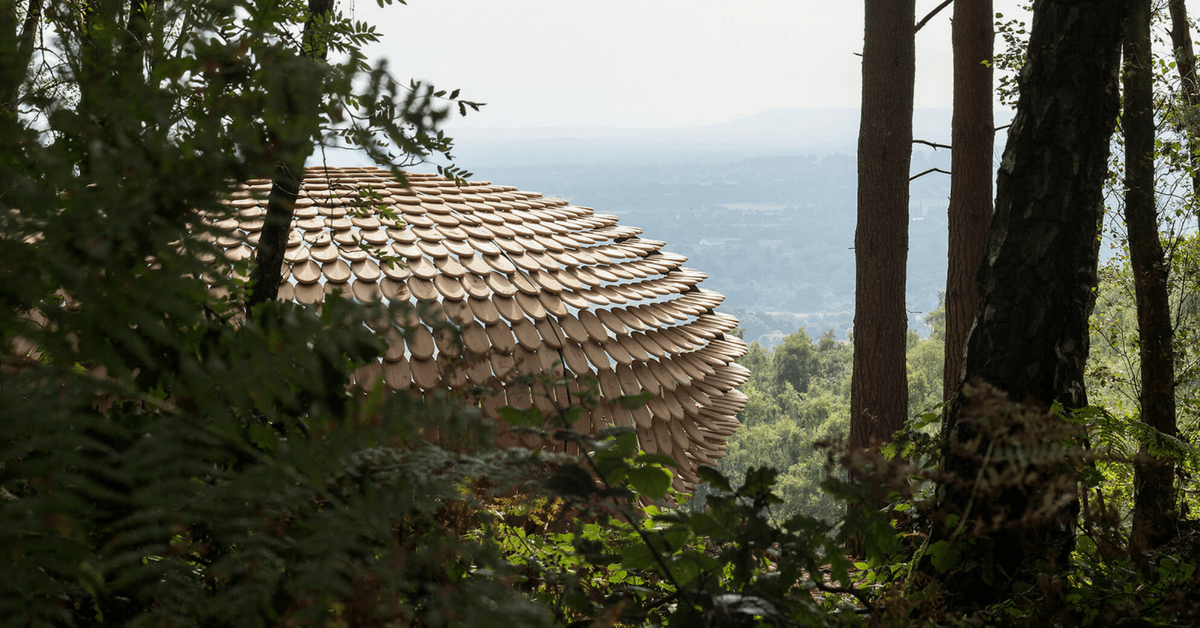
Exposure to moisture causes one layer to expand, which forces the scale to bend in the opposite direction, thus closing the pine cone. Savvy researchers realised this property could be used in a number of industrial, medical or construction applications. One of these was a recent development by scientists from ETH Zürich, who built on this hygromorphic (moisture-sensitive) ability of the pine cone to create a prototype of a system that would provide maximum shade during the heat of the day (low humidity) and less during periods of low light and high humidity. Their sun-shading prototype relies on a system using two different layers of wood (spruce and beech), each cut and joined so that their grain would run perpendicularly to one another, thereby mimicking the structure of the pine cone and its response to humidity.
These planks, arranged in pairs, would change their shape and rotation in reaction to the level of humidity, enabling them to effectively ‘close’ the space created between them when the humidity levels decrease due to sunny conditions. And when the level of humidity increases again, and the temperature drops, the planks ‘open’ to let in more light. While this is not foolproof at this point, the prototype certainly deserves further development as it could be used to create roof or window coverings that operate under their own power, keeping out the sun and keeping interiors cool.
‘We already have automated blinds, but this is is brilliant,’ says Kenneth Dove CEO of Mediterranean Lifestyle.
‘On the automation side, going into 2019 we are seeing a move away from wired motors for blinds, and a larger emphasis being placed on wire-free or battery-operated motors, so this innovation is way on trend.’ adds Dove
Advertisement
The effects of climate change, and more specifically the threat of increased temperatures to life as we know it, is a hot talking point for most of us – unless you’ve been living under a rock for the past couple of decades. So, any product or system that is made from environmentally friendly materials, has low maintenance and operational costs, and results in the cooling of a building without the use of electricity is sure to be a winner.
