
Advertisement
Speeding towards a high-tech, high-rise future, most people, whether they’ve been there or not, have strong opinions about it.
But Thailand’s 244-year-old capital still has plenty of surprises up its sleeve. Astonishingly, Bangkok, where around 11 million people reside across a massively sprawling metro, has existed for a mere 250 years – it’s younger than Cape Town and Stellenbosch, yet is palpably hurtling towards the future, a heady metropolis that’s among the most thrilling places on Earth.
Its energy is intoxicating – the neon signs, the golden sheen of temple pagodas, the sky-high architecture, the jollity and jostling for space in frostily air-conditioned malls where Bangkokians escape the heat of one of the world’s most sweltering capitals. Never mind the throngs of tourists who come to shop, play, explore and party – with over 30 million foreigners arriving annually, it’s the most visited city on the planet.
The sheer variety of what’s on offer is unrivalled. If its 400 Buddhist temples don’t captivate you, its fantastical accommodations surely will. There are some 215 five-star hotels in the city, and many more exquisitely designed boutique spots available at bargain prices. Can’t get a room at the ultra-swanky Aman Nai Lert which opened in 2025? Then try Siri Sala, the five-room waterfront hotel which featured in season three of The White Lotus – it has its own boat dock and spa.
Once you’ve found a bed, ease yourself into the spirit of it all with tickets to a Muay Thai tournament at Rajadamnern Stadium, or catch an all-male cabaret (essentially a drag act with incredible costumes, outrageous wigs and imaginative choreography) at Calypso, a touristy-but-polished show with a huge cast of pretty young (and not so young) dancers lip-synching to international pop hits.
And, if you’re not staying somewhere with an in-house spa, remember to make liberal use of the multitudes of parlors proffering traditional Thai massage, an experience that combines detoxification and relaxation – and a touch of torture.
Advertisement
Massage is so fundamental to the Thai understanding of wellness that there’s a museum dedicated to it at the Temple of the Reclining Buddha (Wat Pho). Near the Grand Palace (the busiest attraction in the city), the temple houses a spectacular 46m long statue of the Buddha lying down and looking blissfully relaxed. Before visiting, you can pick up a floral temple offering from the 24-hour Pak Khlong Talat flower market. Hundreds of vendors sell all manner of blooms – orchids, carnations, marigolds – and create elaborate funeral and wedding displays. And they’ll help you pick out a garland to leave at the Buddha’s feet.
A secret worth knowing is that, across from the main temple building, the Wat Pho Thai Traditional Medical School (look out for the yellow sign) offers excellent foot and back massages in a no-frills, communal environment – the cost is minimal and you’ll soon float off on a cloud of Buddha-like bliss.
Later, if you’d like to float back in time a bit, take a boat to get a sense of Bangkok’s origins as a small settlement where most people lived on water. Perched along the banks of some 1,600 canals (khlongs) is a fascinating world of derelict rice mills, hidden temples poking through the foliage, and wooden houses precariously balanced on stilts, some of them shuttered and half-submerged. Our engine-powered longboat, similar to the one 007 commandeered for a high-speed chase through these canals in 1974’s The Man with the Golden Gun, collected us from a mooring point walking distance from the Grand Palace. We sped across the width of the Chao Phraya River and then slowed into the watery maze of khlongs that thread through the city west of the river.
While the khlongs are clues to Bangkok’s past, it’s future is written in the sky in the guise of fabulous high-rise architecture. For a knock-out high-altitude experience, we bagged sunset tickets for Mahanakhon SkyWalk, at the top of the soaring King Power Mahanakhon skyscraper. Formerly the tallest building in Bangkok, it looks like a mirror-covered game of Jenga. The elevator ride up gives away nothing, but at the very top, reached by another elevator and a spiral staircase, an open-air multi-level rooftop viewing deck is set up with a bar, while a DJ spins tunes to match your sense of exhilaration as you gaze across the city from high in the sky. There’s even a transparent deck, said to be the world’s largest glass tray, cantilevered over one side – step on to it, look down between your feet and you see all the way to the pavement, 314 metres away.
Down below, Bangkok’s global reputation for boundlessly uproarious nightlife is tempered by its equally famous street food. After dark, along Chinatown’s well-trodden Yaowarat Road, there’s a veritable human conveyor belt of hungry people hoofing it between an endless assortment of food stalls serving everything from ebony-hued scorpions to skewers of fresh fruit, plump shrimp dumplings, mango sticky rice, Tom Yum soup and coconut pancakes. Whatever you do, don’t skip Pa Tong Go Savoey, a Michelin-recommended spot turning out Patongko, freshly-made doughnuts fried to perfection (crisp outside, soft and fluffy inside) and served with pandan custard.
And then there are the rising stars of Bangkok’s burgeoning fine-dining universe. Not far from Yaowarat, between a bohemian shuffle of shops and photogenic murals, cocktail bars, avant-garde galleries and pop-up thrift stores along creatively fired-up Song Wat Road, you’ll find Potong. Tucked down an alley off another alley, this Michelin-star outpost of culinary cool is run by Pichaya “Pam” Soontornyanakij, rated the world’s top female chef in 2025 and a main judge on the latest season of MasterChef Asia.
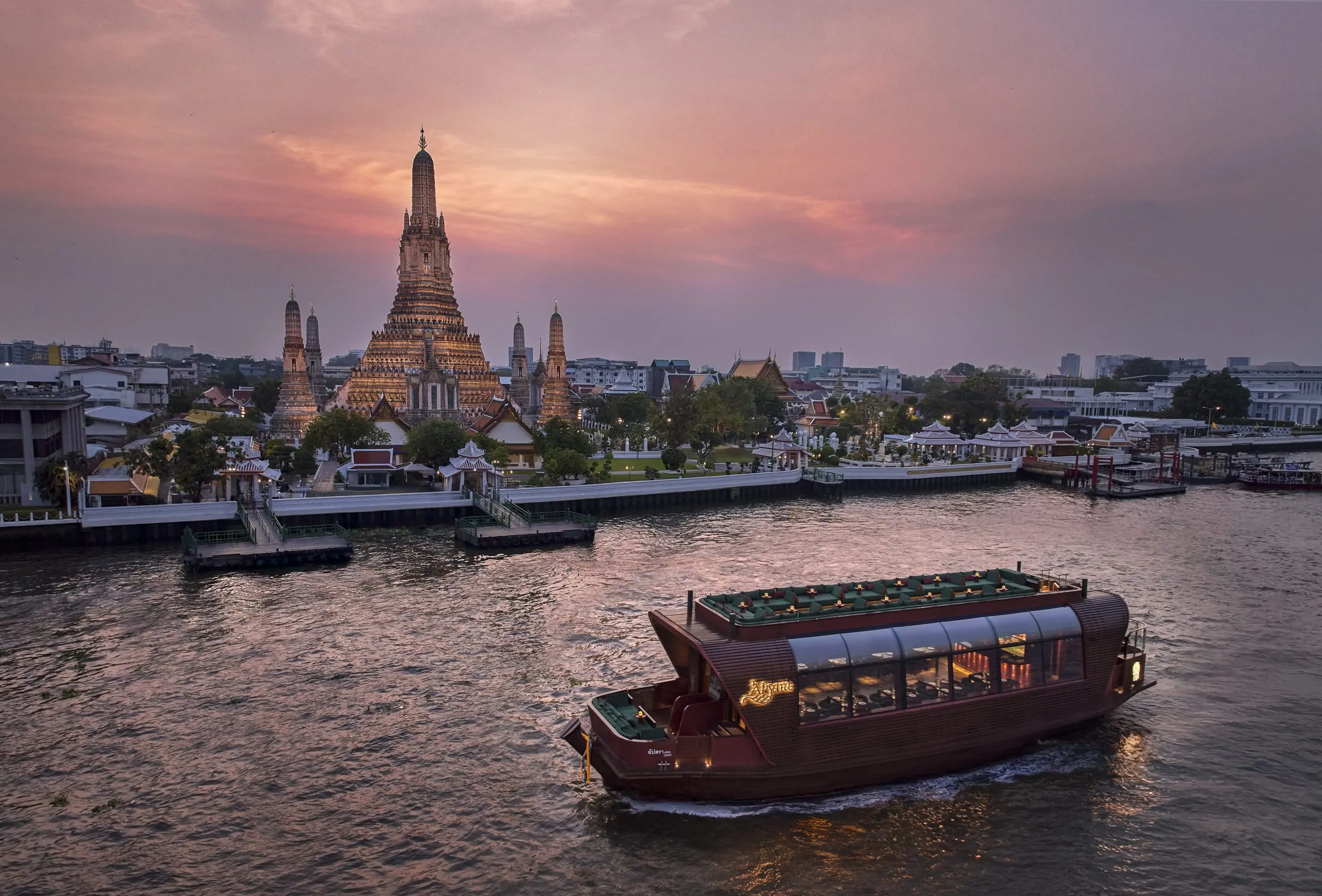
The meal that took my breath away, though, was served aboard the Apsara (“Dancing Angel”), a restored antique rice barge that feels more like small floating palace, with glass walls and handpainted murals reinterpreting Thai mythology. Between the lifejacket demonstration, being serenaded by a violinist, and a succession of innovative dishes, I spent time on the open-air roof deck and through the hot, humid air observed the neon-lit city pulsate and groan under the weight of 250 years of human endeavour. We drifted up and down the Chao Phraya, passing illuminated temples, riverside malls, skyscrapers, fairground rides and dinner boats hosting celebratory karaoke parties. It was, in so many ways, an intoxicating fever dream. One I did not want to wake up from.
